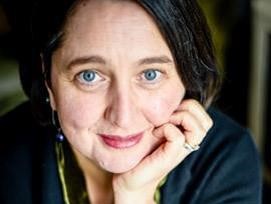
On Wednesday the 9th June we had the pleasure in welcoming Dr Ailsa Holland co-creator of the feminist history Twitter account @OnThisDayShe and co-author of On This Day She: Putting Women Back into History, One Day at a Time (2021). She is a poet, artist, writer, TEDx speaker and activist. This was an extremely interesting talk to over 80 women rounding off our current season on Inspiring Women.
Ailsa’s poetry pamphlet Twenty Four Miles Up was published with Arts Council England support in 2017; she was Manchester Cathedral Poet of the Year in 2019. Ailsa’s word-art has been exhibited in locations around northwest England, including St Ann’s Church in Manchester and the pavements of Macclesfield. Her Library in the Landscape is a much-loved feature of Tegg’s Nose Country Park, Cheshire.
Ailsa explained that the project began after having received a calendar of historical events and finding that each month hardly any women were mentioned. This infuriated her and led her to discuss this with her friends Tania Hershmann and Jo Bell. This discussion resulted in a daily Tweet @OnThisDayShe in 2018 which would highlight something remarkable that a woman had achieved.
The three women continue to Tweet daily and have never found it difficult to find more and more women, in fact, the difficulty is to choose which one to highlight. Some women are well known but many more are unheard of. The Twitter account now have over 31k follower. 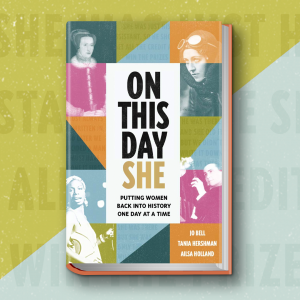
Ailsa started by quoting Joanna Russ who was an American writer and feminist. Here is part of what she said:
- She was there
- She was there and she didn’t do anything
- She was there and she did something, but she was only the wife/mistress/courtesan/girlfriend/muse so she doesn’t count
- She was there, and did something, but it wasn’t her idea, she was just his assistant, so he should get all the credit and win the prizes
- She was there and she did it and it was her idea and no one else helped, but it was at home so really it was a hobby/craft so it wasn’t important
- She was there and she did it but only because she was very masculine – she insisted on wearing trousers for goodness’ sake, so she was pretty much a man anyway
Women highlighted included (there were so many more):
Dr Virginia Apgar – scientist discovering the Apgar score used to assess newborns. She was discouraged to continue as a surgeon because so many women did fail and became an Anesthesiologist.
Frances Glessner Lee from the US who wanted to become a doctor, but her parents did not agree. Her parents died when she was in her 60’s and she decided to set up a library at Harvard University for forensic studies. She took up a position as a Captain at New Hampshire Police training officers. She is known as the mother of CSI.
Erricka Bridgeford lives in Baltimore in the US which has the highest murder rate in the US. The death of her brother inspired her to focus on ending violence. She launched a 72 hours cease fire in 2013 so that gangs would stop killing. They have repeated this and in 2018 this ceasefire lasted eleven days.
Annie Edson Taylor became the first person to survive a trip over the Niagara Falls in a barrel in 1901. She said “No one should do that again”. She hoped to earn some money but spent it all trying to get her barrel back from her manager.
Elizabeth Wilkinson considered to be the first female boxer in the 18thC.
Ailsa particularly highlighted Mo Mowlam who was instrumental in the Good Friday Agreement in Northern Ireland but was never mentioned in the 20 years celebrations in 2018. Her daughter was heard to be screaming at the TV.
They have also included ‘bad women’ such as the only female Nazi doctor and convicted war criminal, Herta Oberheuser. Ailsa explained that it’s important to understand that women in history are not always good. They get a lot of flak on Twitter for highlighting the bad. Its important to learn about all women and apply the same standards.
Alisa spends time speaking to school children explaining how difficult it is for women to achieve but nevertheless they have managed to do so. It does not mean it is easy but often obstacles are put in their way. The move to women’s equality has not been a straight line and it was particularly bad in the Victorian era but education and knowledge is important. Alisa said that she is in this to help future generations.
Fiona Barry from Frodsham WI gave a heartfelt and excellent vote of thanks and was particularly fascinated by the talk as a Librarian. She said there were so many women she needs to read up on now and thanked Ailsa for her fascinating talk. Jean Harding, Chairman, closed the talk thanking members for their continued support.
What did our members think:
Mandy P Cheadle & Gatley : sounds like there’s plenty to fill a second book!! Think Im gonna be scrolling back through the twitter feed all evening!!
Dorothy Higher Walton : Brilliant talk – so informative- just downloaded book onto my Kindle
Helen Romiley : Fascinating, informative talk, looking forward to reading your book. Thank you.
Fiona Frodsham : Ailsa, I should say that you should get a WI diary as every day we have a fascinating fact about a woman’s achievement, and that might give you some food for thought!
Sarah K – Heaton Mess : Ailsa will be one of these amazing women in history in the future
Tracey Cale Green w.i : Thank you was an amazing talk. Thank you Alia and Wendy
Link to On this Day She website: