
CFWI Resolution Meeting 6th May 2021
We were delighted to welcome over 120 members to our virtual resolution meeting. For those of you who were not able to attend here is a brief write up of the evening. And for everyone whether you attended or not there are several links at the end that you may find of interest.
You may wish to use this report at your resolution meeting. Click here for a PDF version CFWI Resolution Meeting 6th May 2021 notes
Federation Chairman, Jean Harding, opened the meeting with a word to our delegates to the Annual Meeting on the 8th June. All delegates have been contacted and they should address any queries directly to Jean rather than to the office.
Alia el Asmar, CFWI Resolution’s Adviser then shared the proposed resolution (above) and introduced our 2 speakers. Ruth Grigg Information Manager at Ovacome and volunteer speaker Mary Raftery.
Ruth told us that Ovarian cancer is considered relatively rare affecting 1:50 women. The cause is unknown, 83% of cases occur in women over 50, and usually post menopause. With no obvious signs it is often diagnosed late, there is no screening and GPs often miss it.
Ovarian cancer is one where the symptoms ‘whisper’, our ovaries are tucked deep inside the body but women know their bodies better than anyone else and it is important for women to know the signs.
Risk factors include age and a family history of cancer. 15% of cases are genetic, caused by a mutation of the BRCA gene which can be carried by both men and women and passed on. One risk factor is that reproductive history has an impact. If you haven’t had children and haven’t had any pregnancies then that does theoretically increase risk because anything that inhibits ovulation is protective for ovarian cancer. That also means the contraceptive pill can be protective, but statistics are statistics and Ruth pointed out that at Ovacome they know of many women who have had children and later in their lives have gone on to develop ovarian cancer.
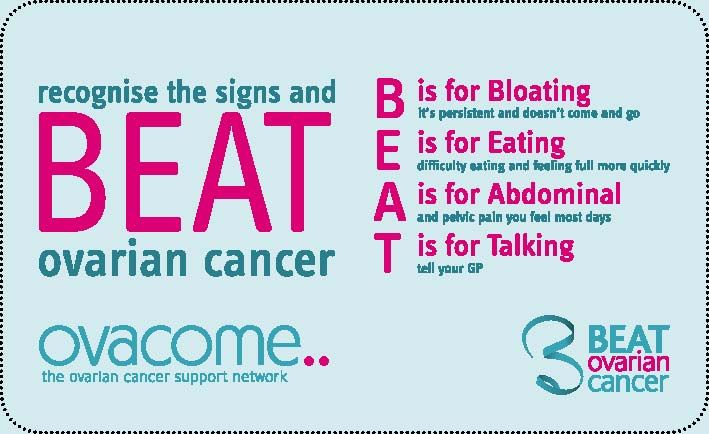 Symptoms. It has taken a long time for the medical community to agree on what the symptoms are. The ‘whispering symptoms’ are summed up by Ovacome’s Beat campaign
The B for Beat stands for bloating, persistent abdominal bloating, different to that which may be experienced during the menstrual cycle. It can be extreme with women talking about looking as though they are pregnant when they know they aren’t.
The E in Beat stands for eating and means difficulty eating, feeling full much earlier having eaten much less than normal. This will be due to blockages in the stomach or bowels caused by the cancer itself or fluid which is made by the cancer.
The A stands for abdominal or pelvic pain. It occurs most days and is persistent and getting slowly worse.
The T of BEAT is for toilets and refers to changes in your toilet habits, perhaps needing to pee more often, getting up frequently at night or being uncomfortable when out and always searching for a loo. Also, it refers to bowels, experiencing constipation in a way that is new for you and persistent or the other extreme and experiencing diarrhoea in a way that is for you new and persistent.
The symptoms are not obvious around the ovaries and very easy to mistake for gastric problems and many women are referred by their GP for investigation of the bowel which will miss ovarian cancer. Many women self-diagnose with IBS and buy treatments for it. It is important to know that irritable bowel syndrome is a condition that affects younger people, a disease of the 20s and 30s so for it to arise for the first time when you are over 50 is really rare, actually more unusual than ovarian cancer.
Many women expect changes as they get older and it is easy to explain away symptoms. It is important to look at them as a collection of symptoms. Most women who go to a GP with these symptoms will not have ovarian cancer and Ruth hopes that we will never need to use ‘BEAT’ or this knowledge.
With no screening it is very important to be aware of our bodies and spot symptoms which are persistent and seek help from a GP for them.
Mary then told her own story of Ovarian Cancer. In 2011 she was diagnosed with at least stage 3c ovarian cancer. She was 55 at the time and had no children. In the February of that year she had taken early retirement from her job at a large teaching hospital. She had been feeling tired for quite a while but had put it down to having a stressful job and that she was going through a long-drawn-out menopause. She had been experiencing some abdominal pain but assumed that was another symptom of menopause. She expected to feel much better after retiring but 4 months later felt more tired than ever and had started to have stomach upsets everyday after eating. She also seemed to be putting weight on round her middle and was surprised as she had been eating less as her appetite had decreased. She started to feel anxious as she recognised symptoms of ovarian cancer having seen them listed at work. In July she saw her GP who thought it was probably an upset stomach but it would be a good idea to do the CA125 blood test to see if there was any indication of ovarian cancer as Mary had expressed her concerns. She was also sent for a scan. The normal range for the test is up to 35 and Mary’s came back at 1255. Mary guessed she probably had quite late-stage cancer. She had an ultra sound test and then she saw a consultant for the first time who told her that she probably did have ovarian cancer but would need to have more scans. She had an MRI scan and CT scan. She was admitted for a biopsy and drainage of acites, the fluid that can build up in the abdomen. Mary said at this stage she looked as though she was 7 months pregnant. The biopsy confirmed stage 4 ovarian cancer with secondary in the omentum, lymph nodes and the spleen. She also had fluid in the lining of her lungs which explained why she had felt increasingly breathless.
She was told the best treatment for her was to have 3 cycles of chemotherapy followed by surgery followed by 3 more cycles. She was warned she would lose her hair but reassured it would grow back again after treatment. 3 days before her first treatment she married her long-term partner. She cried when she promised to look after her partner in sickness and in health as she didn’t think she would ever get that chance. Her treatment took place in the hospital where she had worked for over 20 years and although the treatment made her feel awful it did seem to be working with the CA125 levels coming down to 705 after one round of treatment and her tummy seemed to be getting smaller. Her hair fell out so she relied on a wig and eyeliner and eyebrow pencil to transform her back to someone she recognised in the mirror. She felt sick and dizzy with the second treatment which was halted due to an allergic reaction, but she was able to continue. After the 3rd cycle, she had a CT scan which showed significant improvement and she was ready for surgery which took place in November 2011. She had a hysterectomy, removal of the ovaries, the omentum the lymph nodes and the spleen. Having no spleen leaves her vulnerable to chest infections and covid so she takes a low dose of antibiotics everyday as a preventative. The surgeon was very pleased, almost all tumours had disappeared and those that remained had reduced in size. Mary made a good recovery and was discharged a week later and began chemo at the beginning of December. She continued to suffer nausea, insomnia and other side effects each time but the end was in sight. Her last chemo was late January 2012 and the scan in February showed no abnormality. Her oncologist told her that no one could promise her the cancer would not recur and she should try to live her life on the assumption that it wouldn’t otherwise she would be paralysed. She felt for her that was very good advice and stopped her looking over her shoulder all the time and helped her enjoy the time she had. It is now coming up to 10 years since she was diagnosed with Ovarian cancer and for the last 5 years she has been having follow up appointments once every 12 months. She had a shock in 2015 when she discovered she had breast cancer but thankfully it was the less aggressive kind and had not spread to the lymph nodes and was treated with a lumpectomy and radiotherapy which she did not find as much of an of an ordeal. She was tested for the BRCA gene mutation at that time but does not have it. Totally by coincidence she had her annual test on the day of our meeting and because there has been no reoccurrence in 10 years and everything seems to be okay she has been discharged. Members were delighted with this news.
Ruth then answered a question on CA125, A member asked why we don’t have CA125 screening. Ruth explained it is a marker of protein in the blood, not specific to ovarian cancer. A raised level could indicate ovarian cancer but could also indicate fibroids, or because you are having your period or have some other inflammation or condition which is much less serious. There is no screening programme currently.
A CA125 test is what your GP should test for if you go with the symptoms described earlier. The test is an inexpensive blood test. In a healthy person the reading would be expected to be below 35 and if it’s more than 35 your GP should refer you to an Ultra Sound Scan. This could be a scan over the stomach or a vaginal scan. If the scan doesn’t show anything suspicious the GP should try to find the reason for the symptoms. If the scan showed a mass, then more testing should follow. If the CA125 level is below 35 but you are still having the symptoms the GP should find out why. If no cause is detected the GP should ask you to come back if the symptoms are persistent because the key to this is the persistence of those symptoms and the GP should be taking it very seriously if you are having symptoms which are new for you and are ongoing. Ruth reminded us to remember that we are experts on our own bodies and what feels right.
The hope is that this talk will give members the confidence to go to the GP if they ever have these signs and symptoms. NICE guideline number 122 is on early diagnosis of Ovarian cancer and treatment protocols.
Mary’s cancer was described as Stage 4. Cancer is described in stages, Stage I in ovarian cancer means it would be still confined to the area of the ovary. Stage 2 is where it would have spread a little more, Stage 3 would mean it would probably be in the abdomen and in Stage 4 it may be in more distant organs. Ovarian cancer is often diagnosed late. If you are diagnosed at stage 1 then statistically you have a 90% chance of surviving 5 years. A later diagnosis can mean a less favourable outcome.
Members were then invited to ask questions some points raised included that women often go to the GP apologising for taking up time. Going armed with information can help the GP and shouldn’t be seen as a challenge. If a GP was unhelpful then ask for another GP. A good question to ask oneself is when did you last feel well? The GP needs to see you as an entirety.
Some women present very ill at a very late stage and there is not much that can be done. Sometimes it’s due to people being very inhibited at discussing symptoms linked to the bowel or reproductive area and being examined.
Ruth was not aware of a study on whether early menopause decreases the chance of ovarian cancer. Although most women are older there are examples of younger women getting it and there are incidences of women who have had their ovaries removed getting a reoccurrence.
Vote of Thanks Trustee Georgina Denny -Vice Chairman and CFWI Chair of Public Affairs gave the vote of thanks.
Trustee Sybil Graham put points to consider against the resolution, she referred members to P17 of April WI Life where points to consider are listed. 22 years ago, Cheshire Federation put forward a resolution to support research into a test for Ovarian Cancer and to urge the government to provide test centres. This mandate remains live.
Arguments against are that there are many organisation campaigning for ovarian cancers, there are tv adverts and social media campaigns. Some may argue why NFWI should spend money providing resources to all WIs in the country when others are working on it.
Sybil was thanked and Alia asked members to go back to their WIs to help disseminate the information
Jean Harding brought the evening to a close.
Links of interest
The government is holding a consultation on forming a Strategy for Women’s Health which runs until 11.45pm on May 20. You are urged to try to complete it if possible. It can be found at https://consultations.dhsc.gov.uk/talkwomenshealth
Ovacome free supportline, open weekdays 10am -5pm 0800 008 7054
Ovacome website: www.ovacome.org.uk
Beat campaign and information materials: www.ovacome.org.uk/b-e-a-t
More information on ovarian cancer and genetics: www.ovarian.org.uk/ovarian-cancer/brca/
NICE guidelines on the detection of ovarian cancer: https://www.nice.org.uk/guidance/cg122